

Chief Minister Siddaramaiah becomes Karnataka’s longest-serving CM, surpassing Devaraj Urs with over seven years in office, celebrating his political journey.

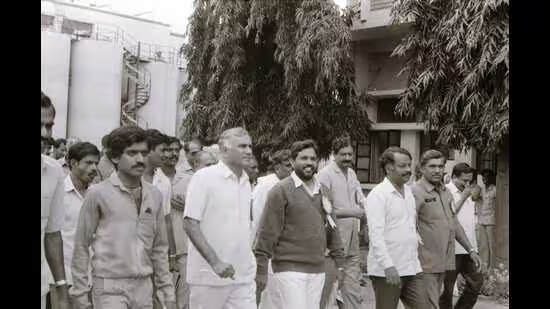
A young Siddaramaiah (in sweater) participating a Janata Parivar programme during the early years of his political career. (HT PHOTO)
Chief minister Siddaramaiah on Wednesday became the longest serving chief minister in the state’s history, surpassing the record held by former chief minister D Devaraj Urs by clocking a cumulative total of seven years and 240 days across two terms in office.
“Records are meant to be broken,” he told the media, drawing an analogy to compare his feat with that of Virat Kohli breaking multiple records set by Sachin Tendulkar.
Nearly fifty years ago, in 1978, during Devaraj Urs’ tenure as chief minister, Siddaramaiah’s self-professed ambition was to become a member of Mysuru taluk board. His desire was to enter Vidhana Soudha as a member of the legislative assembly and follow the footsteps of Urs. In 1983, two years after Urs’ second term in office ended, Siddaramaiah was elected to the legislative assembly on a Bharatiya Lok Dal ticket.
Speaking to reporters on Monday as the achievement drew closer, he had said, “I had only thought that I will be an MLA after becoming a Taluk Board member. I never imagined even becoming a minister, let alone the Chief Minister.”
In 2013, he became chief minister for the first time, heading a Congress-led government. He was appointed for the second time ten years later, beginning his present term in 2023.
On Monday, Siddaramaiah had also delineated a clear distinction between himself and Urs. ““Devaraj Urs was not socially backward. In fact, he was from a forward class, the ruling class. He was from a community which is less in population, but he was a popular leader.”
However, throughout the course of Siddaramaiah’s career, many have drawn parallels (and made other distinctions) between his political career and that of Urs.
Both leaders were born in Mysuru district. In 1972, he became the first chief minister to represent a community classified within the other backward classes (OBC) in the state. He represented the Arasu or Urs, a community of miniscule population linked to the erstwhile royal family in Mysuru and classified as OBC.
Siddaramaiah represents the Kuruba (shepherd) community, who are considered numerically significant and also classified as OBCs. Between Urs and Siddaramaiah, three other chief ministers— S Bangarappa, M Veerappa Moily and N Dharam Singh— were from OBC groups.
Another point of commonality noted by political analysts between Siddaramaiah and Urs was their rebellion against their “political mentors”. Urs, who backed former Prime Minister Indira Gandhi during the Congress’ seminal split between the Syndicate faction and Congress (R) in 1969, rebelled against her a decade later and joined the short-lived Congress (S). Siddaramaiah rebelled against his mentor, Janata Dal (Secular) patriarch HD Deve Gowda in 2005 after he was removed as the party’s state chief.
Siddaramaiah and Urs’ strongest parallel is their focus on backward classes, Dalits and minorities to define their support base as well as policy decisions. Both are given prominent place in existing scholarship on the history of the backward classes movement in Karnataka.
Urs’ ground breaking reforms in this regard included the implementation of the Land Reforms Act, in 1974, unde the slogan “land to the tiller”. The Act abolished the tenancy system and redistributed land to landless farmers, who mostly belonged to the backward classes or Dalit communities. The first Karnataka State Backward Classes Commission was constituted in 1978 during his second tenure in power, aimed at identification of socially and educationally backward classes and to provide them reservation in government positions and educational institutions.
He was also credited with coining the term “invisible voters” as a reference to the OBCs forming the majority of his voter base. He also coined the term “Ahinda” to unite Alpasankhyataru (minorities), Hindulidavaru (backward communities), and Dalitaru (Dalits). Urs was fondly called ‘Hindavalita Harikara’ (pioneer of backward classes) and Siddaramaiah is fondly referred to as `Tagaru’ (Ram) or ‘Huliya’ (Tiger).
Siddaramaiah, in this aspect, seems to have carried forward Urs legacy. He has repeatedly championed Ahinda as his core support base. On the welfare front, Siddaramaiah’s most key contribution is recognised to be the Bhagya model of welfare schemes, initiated during his first tenure in power, with the Anna Bhagya scheme, which provided 30 kilograms of subsidised ration to families below the poverty line in the state. Other notable Bhagya schemes include the Ksheera Bhagya scheme, which provides free milk to children in government and aided schools and Anganwadi centres to combat malnutrition. “I know the pain of hunger and the value of food,” Siddaramaiah said in 2013, while implementing the Anna Bhagya.
Political analyst Harish Ramaswamy said that Siddaramaiah was a believer in social justice, with his approach emphasising a concrete, welfare-based approach to equality.In this sense, he has been able to bring smaller communities into the mainstream, added Ramaswamy.
“If this is what he has gotten right, he has not been able to achieve deep shifts in the life of these people. From MUDA plots allotment and misappropriation of funds earmarked for the scheduled tribe welfare scams, handling of communal clashes in Nagamangala and other places is also what he got wrong,” he said.
A close associate of Siddaramaiah for 45 years, speaking on condition of anonymity, said that while Urs was a statesman, Siddaramaiah is a politician. “Urs was instrumental in creating second line leaders who were chief minister material like AICC president Mallikarjun M Kharge, N Dharam Singh, Veerappa Moily and former KPCC president B Janardhana Poojary. Siddaramaiah has created followers, who cannot be leaders. And chief minister aspirants like D K Shivakumar or G Parameshwara are Congress products,’’ he maintained.
Karnataka former minister M C Nanaiah, who has closely interacted with 11 chief ministers, told the HT that Urs was the tallest among them. Nanaiah owes his entry into politics to Urs recalling how from being an advocate in Madikeri, Urs made him contest elections resulting in his three decades as legislator in both Houses of the Karnataka legislature. “In 1978, I was in the court when I was told that Urs was in Madikeri and wanted to meet me in the Sudarshan guest house. In the meeting Urs said he wanted me to contest from the Madikeri Assembly constituency on a Congress ticket against A K Subbaiah, who was leader of the opposition in the legislative council. Subbaiah and I were professional rivals and I told Urs that if I lose the election I will have to leave my practice in Madikeri besides not having the resources to contest the poll,’’ Nanaiah said.
Urs concern for the uplift of the OBCs reflected in his cherry picking of party men for posts. “At one time there were 110 MLAs from the backward classes as Urs used to tour the state scouting for them,’’ Nanaiah said, describing Siddaramaiah as a mass leader and Urs as an OBC leader.
Meanwhile, former chief minister and senior state BJP leader, BS Yediyurappa said it was not right to draw any comparison between Siddaramaiah and Urs.
“Things cannot be compared with Devaraj Urs, who had done good work. His administrative style was different from his (Siddaramaiah). At a time when this government is immersed in corruption, people won’t like such claims of big achievement,” Yediyurappa said
Siddaramaiah, however, chose to give credit to Urs for his political journey. In a post on X on Wednesday, he said, “My political journey has been shaped by the thoughts and achievements of many senior leaders. Among them, Devaraj Urs holds a very special place in my heart. We shared the same ideological convictions, and like him, I too am a son of the Mysuru soil. That bond makes his legacy deeply personal to me.’’